Luggage storage at Tokyo Station is three separate systems sharing one name — self-service coin lockers, staffed baggage rooms or cloak counters, and temporary storage counters set up on the concourse — and each fails differently, which is why the useful question is never "where can I leave a bag" but "which system fits this bag, this hour, and this side of the ticket gate." Coin lockers are sized in centimeters and priced by size class and time block, with large lockers far scarcer than small ones. Staffed counters take what a locker won't, but they run on staffed hours and usually require a claim ticket. Temporary counters appear and disappear. Get the mechanics straight and you can plan the day without knowing a single current price or which wall happens to be empty.
I stopped thinking of station storage as a place a while ago. What I plan is the shape of the day around the bag: where I'll be standing when I want it back, whether that spot is inside the ticket gates or out on the street, and what I do if the size class I need isn't open when I walk up. Storage in Tokyo is not scarce. A slot in one size class, on one side of a barrier, with one closing time, is a far narrower thing than "storage," and that narrower thing is what breaks plans.
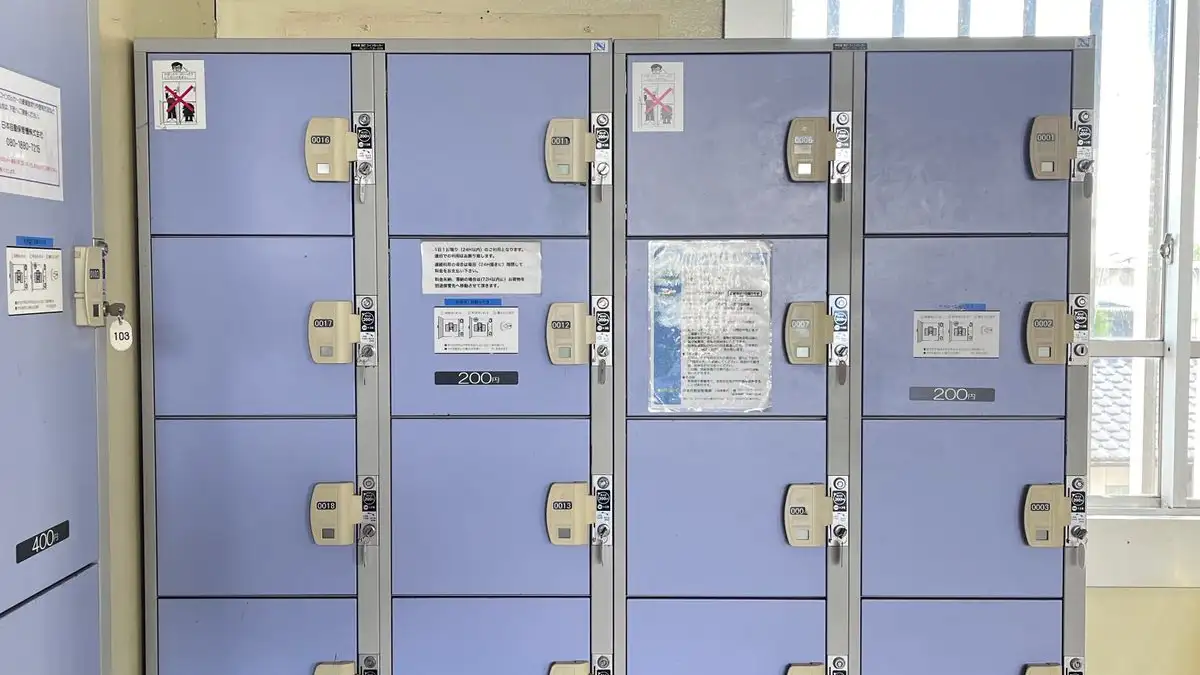
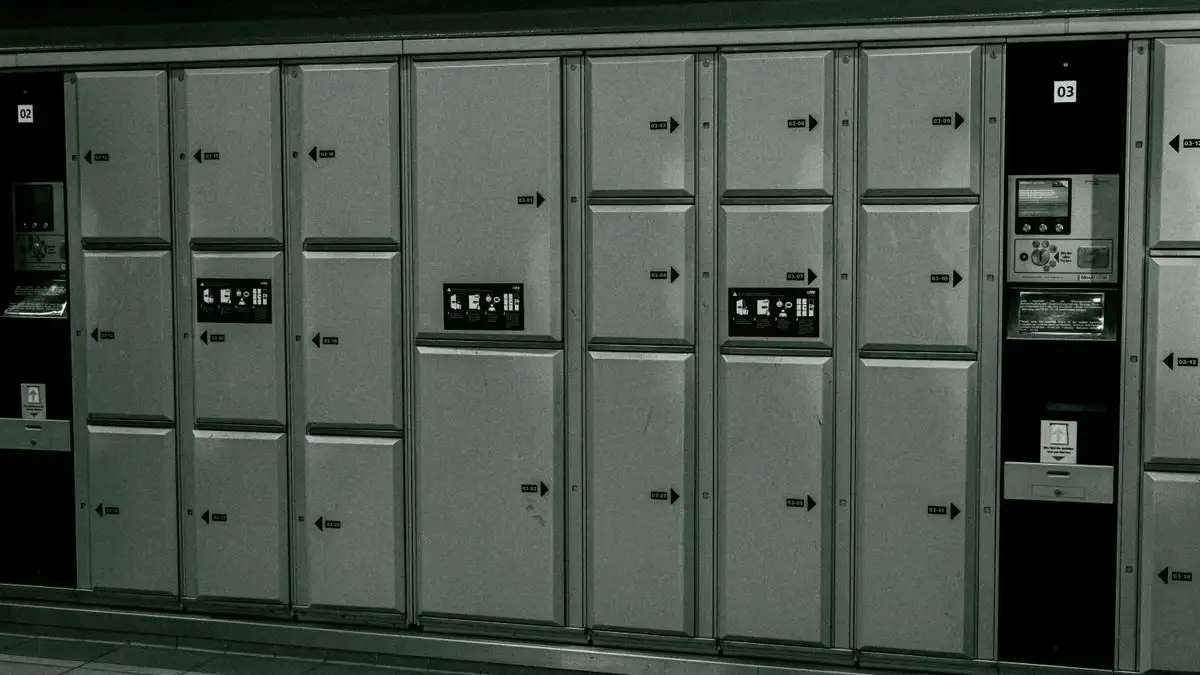
Stand in front of a bank with me. Rows of doors, each stamped with a number and a size class, and above each column a strip with the dimensions printed in centimeters. You scan it the way you scan a parking lot for a space. The small doors repeat three and four deep. The big ones you can count on two hands, and there is usually someone already standing in front of one, reading the same strip, doing the same arithmetic about a suitcase with the handle still up.
Everything else here is detail about which lever to pull.
Three systems, one name
A coin locker is not a service you buy. It's a slot you occupy, and the transaction is over the moment the door closes. That has one consequence that overrides everything else: if the size class you need isn't open, nothing else on that wall helps you. There is no waitlist and no one to ask.
The staffed baggage room or cloak counter is the opposite arrangement. You hand the bag to a person, and a person's schedule becomes part of your plan. What you get back is your bag plus a claim ticket, and sometimes a matching tag on the handle. What you give up is the ability to retrieve at 11 p.m. on a whim.
The third category is the temporary counter — the kind that materializes in concourse space during heavy travel periods, or that a private operator runs for same-day drop-offs. These exist because demand exists. They also close when the demand does, so a plan that depends on one being there is a plan with an unverified assumption in it.
If you remember nothing else: lockers are inventory, counters are appointments, temporary counters are weather.
Sizing: the class is a label, not a standard
Know your bag's three dimensions in centimeters before you go anywhere. Height, width, depth, handle down, wheels included. Doors are not the constraint. Interior volume is, and a hard-shell case that fits a doorway can still refuse to let the door shut.
Two things about the classes themselves. First, "large" at one bank and "large" at another are different numbers; the class is a label printed on a strip, not an industry standard, so the class you need does not transfer between stations. Second, and more important for planning, large lockers are dramatically less common than small ones. Whatever fraction of the wall is big, it's the fraction that empties first and refills slowest.
That asymmetry is the reason the counter exists. If your bag is a full-size checked case, a stroller, a snowboard, a folding bicycle, or anything else with an awkward dimension, treat the locker as a bonus and the staffed counter as the plan.
Payment mechanics: the panel tells you which world you're in
Walk up and look at the payment hardware before you touch anything. A flat dark pad near the door or on a central terminal means IC cards — Suica, Pasmo, and the national interoperable cards — are accepted, along with coins. A slot with a coin entry and a small change return, and nothing else, means you're in the older, coin-only generation of that bank. Some take bills. Plenty don't.
This decides what has to be in your pocket before you arrive. A charged IC card plus a handful of 100-yen coins covers both generations. Carrying only a card, and meeting a coin-only bank, leaves you hunting for a change machine with a suitcase in one hand.
With the card-based banks, the transaction is tied to the card you used. That card is what comes back to the door, not a key you walk away with. Keep it somewhere other than the bag.
The gate line decides more than the location does
Some storage sits inside the ticket gates. Reaching those banks means being in the paid area, which means holding a valid ticket or tapping in with your IC card. If you stashed a bag inside the gates, left, and now want it back, you're buying your way back in.
Flip it and the same rule becomes an advantage. Arriving on a train and stashing before you exit means the inside-gates bank is already on your side of the barrier, and you never pay to reach it.
So decide the side first. Ask where you'll be standing at the moment of retrieval, not where you'll be standing at drop-off, because those are often different. The two sides of a barrier can be a two-minute walk apart and hold completely separate inventories.
One more layer: a station name covers multiple operators. The JR paid area, the metro concourses, and the private railway floors under the same address run their own storage, their own rules on overnight use, and their own item restrictions. "Tokyo Station storage" is not one inventory with one policy.
Time, day counts, and the retrieval step
Locker pricing runs in blocks by size class. Count the blocks the way the sign counts them, because a bank that charges by calendar day is charging you for the date change, not for 24 hours. Dropping at night and collecting the next morning can cross a boundary you didn't plan for. The rule is posted. Read it once at the bank you're using.
Overnight and multi-day storage is possible at some facilities and not at others, and the rule varies by whoever operates that bank. Staffed counters frequently have their own cutoff — same-day only, or a multi-day limit — and they will not negotiate it at the desk.
Retrieval is the step people plan last. Plan it first. Keep the claim ticket on your body, not inside the bag, which sounds obvious until you're the person patting a coat pocket in a concourse. If a ticket is lost, counter staff handle it with identification and it takes time, so don't schedule a tight connection behind it. If a counter closes before your train, the bag waits until the next staffed morning. That's a real failure mode, and it's the reason I choose counters by their closing time before I choose them by their capacity.
What won't go in
Perishables, cash, valuables, and dangerous goods are the standard exclusions, posted on locker doors and at counter desks. Those lists are not decorative. Storage is not insurance, and the facilities generally aren't taking responsibility for what's inside. A laptop, a passport, and anything you'd have to replace from another country belong on you, not in a box you'll see again in eight hours.
Peak windows and the fallback
Weekday mornings and holiday travel periods are when demand for large lockers spikes, and it spikes because the people who need large lockers are all arriving on the same trains. Mid-morning on an ordinary weekday is more forgiving. Nothing is guaranteed.
Which is the argument for building the fallback into the plan instead of improvising it. The order I work in is short: measure the bag in centimeters, decide which side of the gate I want it back on, decide whether I can live with counter hours, check that I'm carrying both payment methods, and know where the staffed counter is in case the big locker isn't there. Four of those five steps you can do from your phone before you leave the hotel. The fifth is the walk.