Match the bag and the duration to the storage type before you walk into the station, because the mismatch — not the price and not the queue — is what actually costs you time. Large suitcases, duffels, and anything with an awkward shape belong in a staffed baggage room or a temporary counter. Small and medium bags on a short stop belong in a coin locker. The detail most people skip is the third variable: whether the facility sits inside or outside the ticket gates, since crossing that line has a cost of its own. Get those three in the right order and storage takes ten minutes. Get them wrong and you're hauling a suitcase back through a gate you already paid to pass.
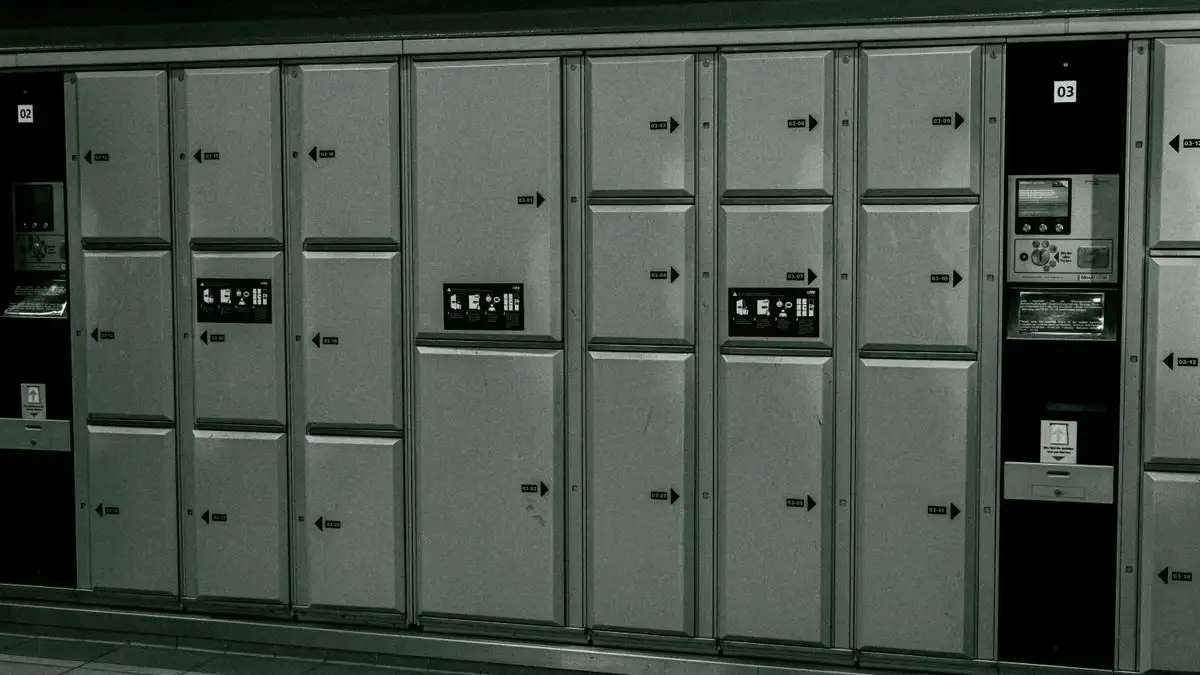
I want you standing where the decision happens. Not at the fare machine, not under the departure board — at the locker bank, a few steps down a corridor, suitcase handle still warm in your hand. You'll see the problem before you understand it. The doors are set in a grid, and the grid isn't uniform: shallow rows at the top, deep rows at the bottom, and one column in the middle that's taller than everything around it. That column is the one you need, and it's already lit up occupied.
Listen for a moment. You'll hear the soft clack of a door being tested, then a beep, then the click of a lock engaging, then a pause. That pause is the half-second where someone works out the bag doesn't fit and the door won't close. It's the most expensive sound in the corridor. It's a plan that didn't survive contact with a centimeter measurement.
The order of the three questions matters
Most people ask them in the wrong sequence. They walk up, find an empty locker, then try to make the bag fit, then think about how long they need it, then discover the whole bank is inside the gates. I run it the other way: size first, then duration, then the gate line.
Size is first because it's the only one that can't be negotiated. You can shorten a stop. You can walk to another entrance. You can't compress a hard-shell suitcase.
Start with the bag, not the locker
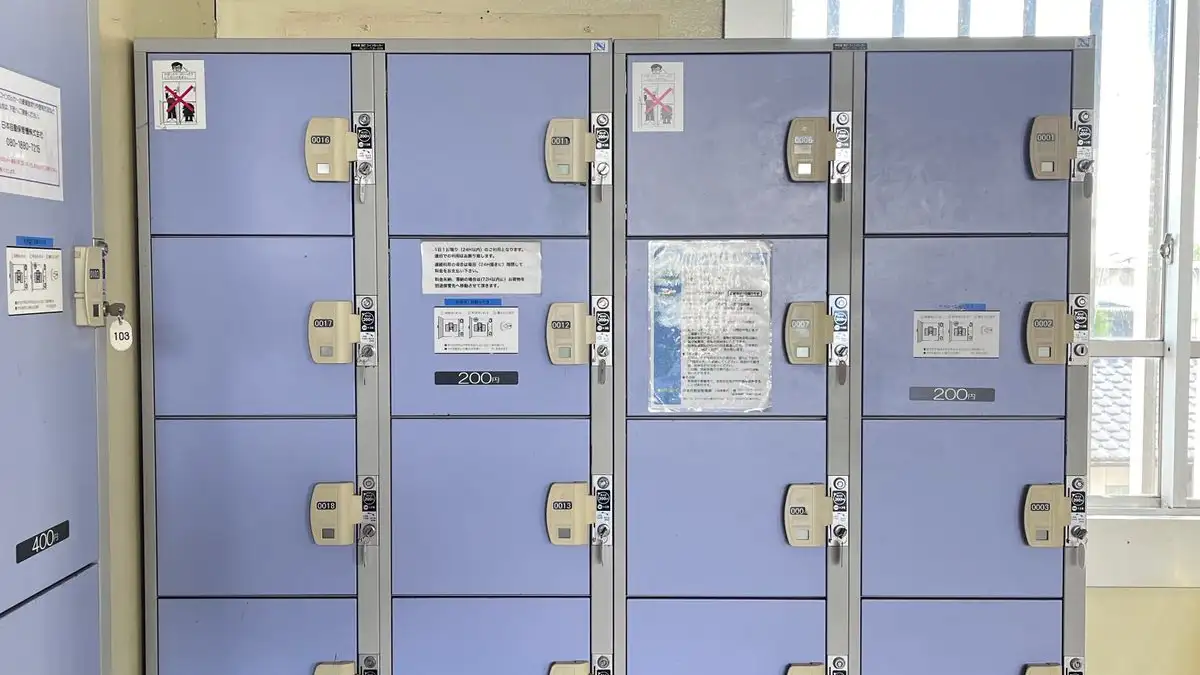
Inside every locker door there's a size chart printed in centimeters, and the doors are grouped into three bands — small, medium, large. Look at the chart, not at the empty space. The band you're standing in front of is not the band your bag belongs to.
The large band is short. That's the structural fact of every locker bank: the shallow doors outnumber the deep ones by a wide margin, and the deep ones go first. If your bag needs the tall column, arriving at eleven in the morning is a different proposition than arriving at two.
Odd shapes are a separate problem. A ski bag, a guitar case, a folding stroller, a bicycle box — these don't fail the size test so much as fail the door test. A locker is a fixed box with a hinge. Anything that won't slide in straight and stay put is a staffed-room item, and the sooner you accept that, the less corridor you cover.
Duration decides more than you think
A locker bank is not a multi-day tool. Most are cleared at the end of the operating day, so if your plan runs past that, you're not choosing between locker and baggage room — the locker has already ruled itself out. Two hours, four hours, a museum and lunch and back: locker. Overnight, or a bag you won't touch again until you leave the city: staffed room.
A staffed baggage room works on a claim ticket. You hand over the bag, you get a paper slip or a numbered tag, you hand the same thing back at the end of the day. Keep it somewhere that isn't the bag. I've watched people pat down a jacket for two minutes because the ticket went into the front pocket of the suitcase they just checked.
Some staffed rooms will ask for identification when the item is obviously valuable — a camera case, a boxed instrument. That's normal, and it's a reason to have your passport on you rather than buried.
The gate line is the part nobody checks on arrival
This is the one that turns a ten-minute stop into forty. Some storage sits inside the ticket gates. To reach it, you need a valid ticket or an IC card with fare on it, and you tap through like any other passenger. If you already have business on the platforms, that's free. If you don't, you're paying a fare to reach a locker and paying again to get back out, and you've added a gate line twice.
Outside the gates, everything is on the concourse — same level as the exits, no fare, no tapping. Stand in the corridor and look for the gate line before you commit. It's usually visible as a row of automatic gates with a low barrier and a signboard above. If the lockers are on the far side of that line, decide now whether the bag is worth the fare, or whether you'd rather walk to an outside bank.
When the locker doesn't fit, ask a person
Station staff will redirect you. The attendant near the gate, or the person at the counter by the concourse, knows where the nearest baggage room is and will point. This is a normal question and it gets a normal answer, and it takes less time than walking two more corridors on your own.
Temporary storage counters are the release valve. They tend to sit near exits or by a tourist information desk, they often take same-day drop-off, and they exist precisely for the case where the locker bank is full or the bag is wrong for the doors. If the bank is saturated and your train is in an hour, this is the move.
Put it together as a sequence
At the locker bank, before you touch a coin slot: does the bag pass the chart on the door in front of you? If yes, how long until you come back — same day, or later? If same day, look for the gate line and pick a bank on the side you're already on. If the bag fails the chart, or the answer to the duration question is tomorrow, stop looking at lockers entirely and find a staffed room or a temporary counter. That's the whole framework, and it fits in one breath.
The cost nobody budgets for
Storage is a round trip. You're coming back to this station, at this entrance, before the day ends, whether or not your evening plans point that direction. That's the real trade-off of picking storage at a big station: the convenience of the morning becomes a commitment in the evening. If your day ends somewhere else, either choose a staffed room you can retrieve late, or accept that the last leg of your day is a retrieval run. I plan the return before I plan the drop-off, and it has saved me more evenings than any locker trick.
The doors all look the same from three steps back. What separates them is a measurement, a clock, and a gate line — and you can read all three before you set the bag down.