You do not need dedicated gluten-free restaurants in Tokyo. You need a working map of where wheat actually enters a Japanese kitchen, a way to check that doesn't depend on your Japanese, and a default meal structure that holds up when nobody in the building understands the question. That default is rice. Plain rice, grilled fish, and undressed vegetables are gluten-free before anyone agrees to modify anything, which is why the days that work in Tokyo are the ones built around ordinary rice-centered meals, with a convenience store as the backstop and one confirmed option near whatever area the day is built around.
I worked this out on my second morning, standing in a convenience store at seven, a rice ball in one hand and a package turned over in the other, staring at two characters I had learned to recognize: 小麦. Wheat. It sat right there on the back, in its own little box, because Japanese labeling rules require wheat to be declared as an allergen. That one box did more for my first week than every gluten-free search I ran before the flight.
The package is more honest than the menu
Here is the inversion that took me a few days to trust. In Tokyo, the packaged shelf is legible and the restaurant menu is not. Labeling law forces wheat onto the label. Nothing forces a kitchen to tell you what went into the pot, and a server who nods and smiles may be agreeing with you or simply being polite.
So my screening moved. I read the back of packages in convenience stores the way I read them at home, and I stopped treating a restaurant menu as information. Rice balls, boxed rice, grilled fish, plain prepared vegetables — each one gets turned over before it goes in the basket. The label does not make every item safe, but it gives me a yes or no I can act on without a conversation.
One nuance worth knowing: a boxed meal that declares wheat means wheat is somewhere in that box, not everywhere. The ingredient list usually tells you which component carries it. If the wheat shows up beside the sauce or the meatball, you know which part to leave. If it appears in the rice, the whole thing goes back.
Wheat without a noodle in sight
This is where most people's mental model fails. They decide to avoid noodles and bread and think the problem is handled. Standard soy sauce is brewed with wheat. Miso is made with a grain koji — rice, barley, or soybean — and barley is common enough that the same bowl means different things at different shops. Neither one looks like bread, and both are all over the plate.
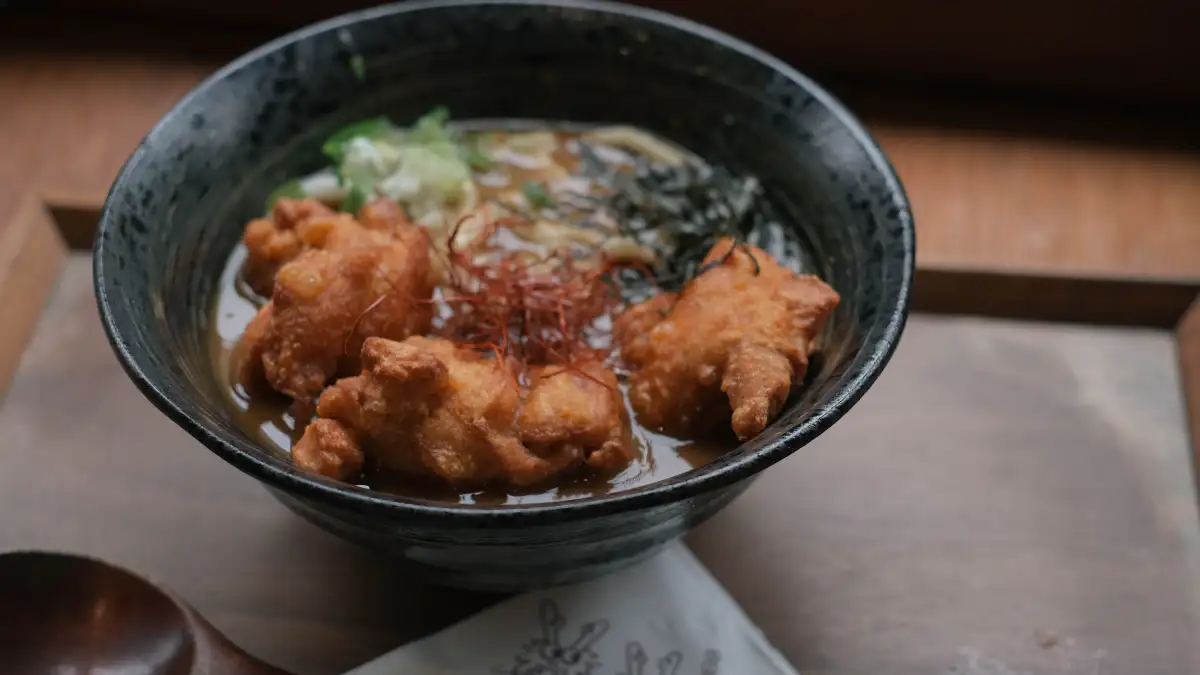
So I learned to think in components rather than dishes. The batter: tempura, okonomiyaki, takoyaki, anything katsu with its breadcrumb coating. The noodle: udon, ramen, and soba, which is usually cut with wheat flour even though the name says buckwheat. The sauce: tare brushed onto grilled meat, the dipping sauce beside the soba, curry roux, which is built on flour. The filler: imitation crab, some sausages, some meatballs. And the surfaces: the shared fryer, the shared grill, the same pot of broth.
A skewer of grilled chicken ordered with salt is a different food from the same skewer ordered with sauce, and that difference is the entire point.
One card, one word, handed across the counter
What changed my restaurant interactions was a written card in Japanese. Not my pronunciation of an explanation — a card carrying the term the kitchen actually uses. 小麦, and 小麦粉 for wheat flour, written plainly, so the person across the counter can carry it back and check it against a container or a label instead of interpreting my accent.
I hand it over before I order, not after. That gives the staff a concrete thing to verify rather than a vague request to be careful. Sometimes they come back with a clear answer. Sometimes the answer is that the dish is built on soy sauce and there is nothing to be done about it. Both are useful, and the second one is the thing a menu never tells you.
"Gluten-free" at a Tokyo venue is not one thing
The phrase covers a wide range. At one end are kitchens built around the restriction, with separate prep and no wheat in the building at all. At the other end are ordinary places that will leave off the obvious wheat items when you ask — the bread, the noodles, the sauce brushed on top — and call it fine.
That range is the real trade-off of the trip. A dedicated kitchen is a certainty, and it costs you geography: you spend an afternoon crossing the city for one meal. An ordinary neighborhood place keeps you inside the day you planned, but its answer depends on that kitchen's understanding and honesty.
There is also a limit no amount of asking fixes. Staff can take wheat out of a recipe. They cannot take it out of the kitchen — the fryer oil, the pot of broth, the board, the tongs. How much that matters to you is not something a travel guide can decide, and I am not going to pretend otherwise. I can tell you where the wheat hides. Where your own line sits is between you and your doctor.
Building the day so one meal carries the next
The pattern that worked for me: one rice-based meal, one convenience-store backup, one confirmed option near wherever the day is built around. The rule behind it is simple — I never stack two unverified meals back to back. If lunch is a gamble, dinner is rice and grilled fish from somewhere I have already checked. If breakfast is a hotel set meal, the evening can take a risk.
Breakfast is the easiest meal of the day in Tokyo. A set meal is rice, grilled fish, pickles, an egg, maybe natto, and a bowl of miso — and the only component worth a question is the miso.
Lunch is sushi or a rice bowl if I am moving. Sushi rice itself is seasoned with vinegar, sugar, and salt, so the rice is not the problem; the soy sauce is, plus anything brushed on top, plus imitation crab, plus whatever the knife touched. When the day does not allow a sit-down meal, the convenience store is not a compromise. It is the meal I can actually screen.
Dinner is where I would rather sit somewhere for a while. Grilled fish, sashimi, skewers ordered with salt, plain rice, vegetables with nothing poured over them. Department store food halls are useful in the late afternoon for the same reason the convenience store is: packaged, and labeled.
The honest cost is repetition. Rice, fish, pickles, rice, fish, pickles. By day five it can feel like eating the same meal in different rooms, and I will not pretend otherwise. What I got in exchange was a trip that kept moving without an hour of research before every plate.
What this approach will not get you
It will not get you ramen, tempura, katsu, or a proper bowl of soba in the broth it was designed for. It will not protect you from a kitchen that says yes to be agreeable. It will not survive a day built entirely around a food hall crawl with no backup in your bag.
What it does is smaller and more useful: it turns gluten-free eating in Tokyo from a search problem into a reading problem. Read the back of the package. Learn the word. Know which components carry wheat. Build the day around rice. After about a week, I stopped looking for places that advertised the right thing and started looking at what was actually in the bowl in front of me — and that is when the trip got easy.