The short answer is yes: you can eat ramen in Tokyo with dietary restrictions, but not by choosing from the menu. Every bowl reduces to two variables — the broth base and the noodle type — and the only dependable way to learn them is to ask a person in the shop before you pay for anything. What comes back is information, not a promise, and you decide what to do with it.
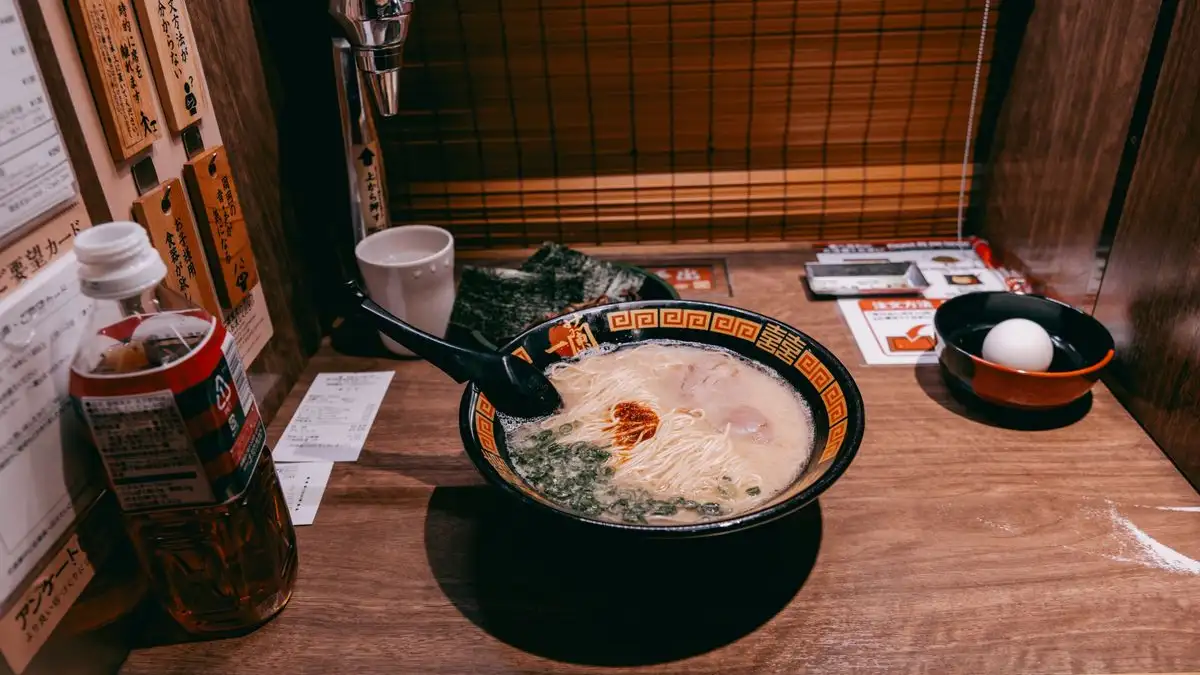
I learned that in a nine-seat shop with a plastic bowl display in the window. Shio ramen, corn, butter, scallions, nori, no meat in sight. I bought my ticket from the machine by the door, sat at the counter, and ate most of it before I caught the note underneath — that low, smoky, dried-bonito taste. Katsuobushi. The bowl had never been vegetarian. It had only looked that way.
Here is the part that took me longer to accept. Broth has no visible meat in it. That is the entire problem. A clear shio and a cloudy tonkotsu can come out of the same kitchen, one of them is pork bones and one of them is chicken, kombu, and fish, and your eyes cannot tell you which. The food display is a photograph of a bowl, not a list of ingredients.
So I stopped picking from the window.
The two questions, and the order to ask them in
I ask about the broth first, because the broth is where the restriction almost always lives, and because the answer comes back fast. スープは肉ですか、魚ですか — is the soup meat or fish — is usually enough. If that's more Japanese than you can hold in your mouth, three words work: 豚 (pork), 鶏 (chicken), 魚 (fish). Point at the bowl, say them with a rising tone, and you'll get a word, a nod, or a shake of the head.
What you're listening for under the answer:
- 豚骨 (tonkotsu) is pork bones, full stop. Not vegetarian, not halal, nothing to negotiate.
- 鶏がら (torigara) is a chicken-bone base.
- 魚介 (gyokai) means fish and shellfish are in it.
- 昆布 (kombu) and 椎茸 (shiitake) are the vegetable-dashi route.
The trap is the menu word. Shoyu and shio are names of seasonings, not broths. "Shoyu ramen" tells you soy sauce went in. It does not tell you what the soy sauce went into. Miso is the same story — miso names the paste, and a miso bowl can still sit on a pork-bone base or finish with a spoonful of pork backfat for aroma. Tonkotsu is the rare name that describes the base itself. Everything else is a label from the seasoning side of the kitchen, and the seasoning is the last thing to worry about.
The second question is the noodles, and it's shorter. 麺は小麦ですか — are the noodles wheat? Standard ramen noodles are wheat, so the honest default answer is yes. A shop with a gluten-free option usually offers rice noodles or konnyaku noodles, and it usually says so on the machine or the wall, because it's proud of it. What you won't see written down is that the wheat-free noodles may go into the same boiling basket as everything else. That's a fact about a small kitchen with one boiler, not a warning. You decide whether it matters for you.
The layer most people never ask about
This is the part I missed for months, and the one I'd want you to know before your first bowl.
The broth is not the whole bowl. Before the broth, someone ladles a concentrated seasoning into the bottom of the bowl — the tare. After the broth, someone often adds a spoonful of aroma oil across the top, which in a lot of kitchens is pork fat, chiyu, even when the broth itself is chicken or vegetable. A bowl can have a kombu-and-shiitake broth and still carry a tare built with fish extract or a finishing oil built from pork.
So when the answer to "is the soup meat or fish" comes back clean, I ask one more thing, and I keep it small: タレは? — the tare. Does it have fish in it, does it have pork? Most cooks know exactly what's in their tare, because they make it themselves, in a pot, in the back.
Then there's everything on top: the marinated egg, the braised pork, the menma, the nori, the butter. Those are visible, so they're easy to remove or refuse. The tare is the invisible one.
Where vegetarian and halal actually fit
I want to be straight about the landscape, because it's uneven.
Vegetarian ramen exists in Tokyo, and it leans on kombu, shiitake, and vegetable dashi — good, deep, savory bases. But it is less common than meat broth, and it clusters in certain neighborhoods rather than spreading evenly across the city. My working assumption when I walk into an unfamiliar shop is meat until told otherwise.
Halal ramen exists too, and it's genuinely good in places, but the supply is limited and it clusters as well. The thing to ask about isn't only the ingredients — it's the kitchen. A shop serving a pork-free bowl can still share a pot, a ladle, a strainer, and a counter with pork. Some shops handle this deliberately; some don't think about it at all. That's a question about the kitchen, not the recipe, and it only has a useful answer if you ask it directly.
Ask before the ticket machine, not after
Here's the mechanical detail that trips up people from the U.S., and it's worth internalizing before you walk in. At many Tokyo ramen shops you order and pay at a ticket machine — the 券売機 — mounted by the door. You press buttons, you feed it cash or tap your IC card, and you hand the ticket to the counter. By the time you're sitting down and able to talk to someone, you've already bought the bowl.
So reverse the order. Walk in, find the person, ask your two questions, then go to the machine. The machine is the first thing you see and the last thing you should touch. If the shop is busy and nobody's free, that's a reason to come back at 2:30 in the afternoon, not a reason to guess.
Keep the questions narrow. You want five words: pork, chicken, fish, wheat, and no. You are not looking for reassurance. You are looking for a cook to tell you what's in the pot. Those are different transactions, and only one of them gets you a straight answer.
I can't tell you that any particular bowl is safe for you — that's yours to weigh, and a stranger on a website doesn't get to decide it. What I can hand you is the sequence: ask the broth, ask the noodles, ask about the tare and the oil, ask about the kitchen, and do all of it before you press a button on the machine. That sequence has never failed me, even when the answer was no.