You do not need to read a word of Japanese to order at a Tokyo ramen shop. The sequence is fixed and short: buy a meal ticket from the shokkenki machine before you sit down, carry that ticket to the counter, hand it to staff or set it on the ledge at your seat, and answer one fast question about noodle firmness with one word. Money leaves your hands at the machine or at the register, so there is no bill, no check presenter, and no tip at the end. The only way this actually goes wrong is standing in front of the machine trying to decode it, because that is the exact minute you are holding up a room full of people who are not decoding it either.
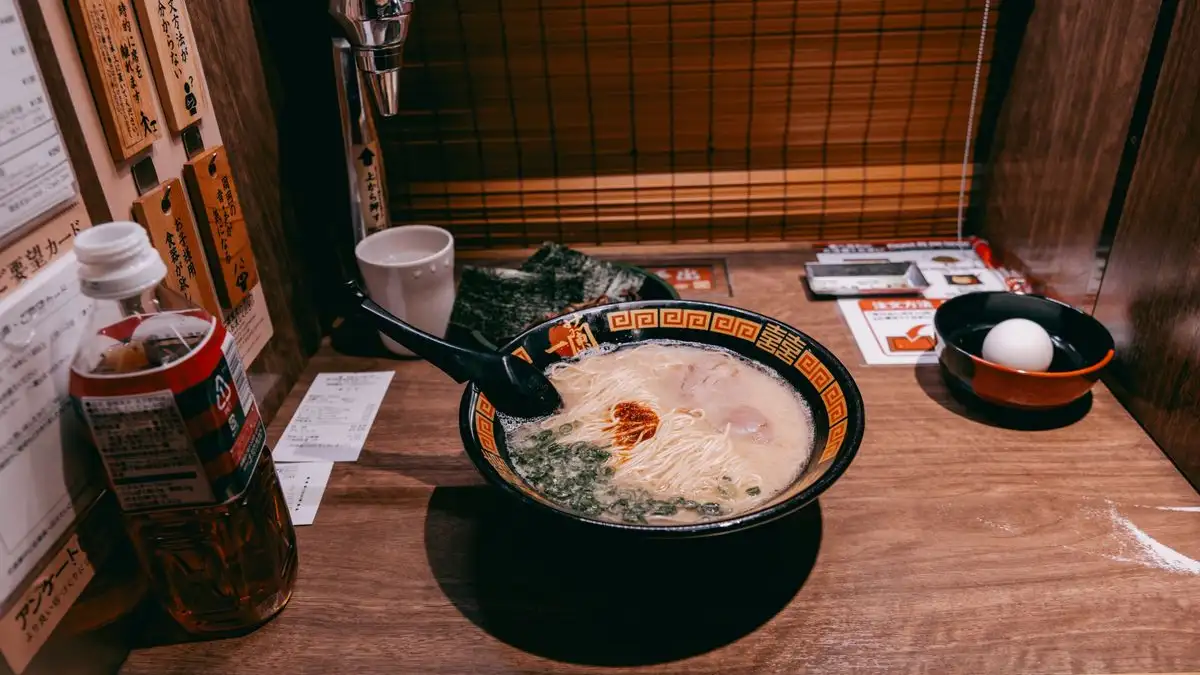
I want you standing where I stand every time: just inside the door, still carrying the cold from outside, a counter of eight or ten seats in front of you, a low shelf running behind them, steam rising off a pot that nobody is turning around from. Nobody greets you. Nobody hands you a menu. Look to your left, because the machine is almost always there, waist-high against the wall, glowing, with a grid of buttons and a bill slot. And look at the hands of the person standing in front of it, because you are about to copy them exactly.
What the panel is actually divided into
A shokkenki machine is not a menu. It is a menu sorted into four bands, and once you see the bands you can stop reading.
The main bowls sit together, usually across the top or filling the top-left block. These are the biggest buttons, often with photos, and the leftmost one is generally the bowl the shop is known for. That is your default. If you cannot make out anything else on the panel, pressing the top-left main button will get you a correct bowl of ramen in a shop you have never set foot in.
Below and beside the bowls are toppings: seasoned egg, extra chashu, bamboo shoots, nori, corn, butter. Then sides, which usually means a small rice bowl, and drinks, which means beer, cola, or a canned highball. Some shops give the noodle portion its own button, so you can buy a larger bowl or a second helping at the machine instead of asking for it out loud.
Many machines have an English toggle. It tends to be a small button in a corner rather than something sitting in the flow of the order, sometimes the word "English," sometimes a flag. It usually translates the labels and nothing else, so it will not explain what "kaedama" means. And a real share of machines, especially in older shops and in station buildings, have no English at all.
When there is no English and no photos
You are not stuck. Read the shape instead of the text.
Main bowls are the widest band. Toppings are the middle. Rice and drinks and small extras sit at the bottom or off to one side. The price ladder confirms it: the most expensive buttons are almost always the deluxe bowls, and the cheapest are rice and add-ons. Pick the top-left main button, optionally add one topping, and you have ordered better than most first-timers manage.
Then figure out the money. Most machines take bills and coins; a growing number also take Suica or Pasmo on a reader pad, which will be obvious if it is there. If you are unsure, cash is the version that always works. Some machines want the money in first, and the bill slot will light up or show a small lamp when it is waiting for you. Others let you press first and pay after. If the bill slot is lit, feed it. If the buttons respond the moment you press them, the machine is telling you it wants the order first.
Two things worth knowing before you commit. In my experience the cash-first, button-second pattern is more common than the reverse, so feed it a bill and let it sit rather than hunting for a coin slot. And you can generally buy a second ticket for an add-on and hand both over together, but doing it mid-bowl is awkward, so decide your one extra now instead of later.
Not every shop has one of these
Worth saying plainly, because it changes the walk-in: some ramen shops have no machine at all. You sit, and someone takes your order, or you fill in a paper slip on the counter with checkboxes. Some shops want payment after the meal instead of before. The tell is easy. If there is no machine by the door, take a seat and wait to be acknowledged, and do not assume you have to pay first. The machine is the common case in Tokyo, not the universal one, and walking in expecting it when it is not there makes you look worse than not knowing how it works.
Where the ticket goes once you have it
The ticket drops out of a slot, usually low, with the change below or beside it. Do not fold it into your pocket. Hold it. That ticket is the only object that matters for the next ten minutes, and your whole order now lives on it.
The handover has two shapes, and the room will show you which one you are in. If a staff member looks at you, or has a hand out, or says something short while nodding at the paper, hand it over. If nobody is looking at you, sit at an open seat and set the ticket on the counter, on the raised lip at your place. Most counters have that lip, and it is where tickets, chopsticks, and glasses live.
The most reliable instruction is not printed on a sign. It is the person who walked in ahead of you. Where did their ticket end up? Follow that. If you sit and nobody comes for a minute or two, do not sit there wondering, catch an eye and lift the ticket slightly off the counter. That gesture reads correctly everywhere, and it saves you from the louder alternatives.
The three words that answer the question you did not hear
When they take the ticket, they will usually ask something quickly. You will not catch it. You need three words total, and you only need one of them.
Katame means firm noodles. It is the most common request in the city, and it works in any shop regardless of what the broth is made from. Karame means stronger flavor, the seasoning in the bowl gets pushed up, so the soup lands saltier and more concentrated. Abura means more oil, usually the aroma oil or the back fat, which makes the bowl richer and silkier without making it saltier.
You can say them in a row, katame, karame, abura, or pick one. If your mouth freezes completely and nothing comes out, they will make the bowl standard and nobody will think about it again. There is no penalty for ordering the default. Some shops remove the question entirely by putting a firmness button on the machine or a checkbox slip on the counter, in which case you have already answered and should say nothing.
Water, ginger, and everything else that is free
Water comes from a dispenser at the counter or a plastic pitcher, with cups stacked nearby or on the shelf above. It is self-service, and refilling your own glass is the norm, not rudeness.
Along the counter you will usually find red pickled ginger, pickled mustard greens, a sesame grinder, white pepper, vinegar, chili oil, and sometimes a garlic press. All of it is free and meant to be used, including by you. The tissue box at the counter is your napkin. Baskets or hooks under the counter take a bag or a jacket, which matters more than it sounds, because these counters are narrow and a backpack on your lap puts you in everyone's way.
The money is already gone
You paid at the machine or at the counter. If it was the machine, your change came out with the ticket. If you tapped an IC card, it is finished. There is no tip, and leaving coins on the counter actually creates a small problem for whoever is cleaning up.
When you are done, put the bowl back on the ledge or leave it where it is, wipe up anything dramatic, return the glass to the shelf, and go. Turnover in a ramen shop is measured in minutes. Sitting with your phone out while people are standing at the door is the one thing that reads as a mistake.
The fear at that machine was never really the Japanese. It was the six people behind you. Which is why the preparation is not studying a menu, it is knowing the shape of the panel before you step through the door: one bowl from the top band, maybe one extra, money in, ticket out, hand it over or set it down, and one word if you want your noodles firm. Expect the machine to differ in every detail, the layout, the money order, whether it takes your Suica, and expect the shape to be identical every time. And if you still need ten seconds, step to the side of the machine. That move is always allowed, and it is the one that keeps you from being the person the whole counter is watching.