A ryokan guest room is a raised reed floor with a rulebook built into its surfaces, and nearly every mistake a first-time guest makes comes from reading it as a hotel room with different furniture. Shoes, hard-soled slippers, and rolling luggage stay off the tatami. The bed is folded in a closet and does not exist until evening. The clothing on the hook is for inside the building. Slippers wait at the room's entry, and a second pair waits inside the toilet and never leaves it. Those five facts generate almost everything else that catches people out on the first night: the low table instead of a desk, the room that changes shape twice a day, the suitcase that has nowhere to sit.
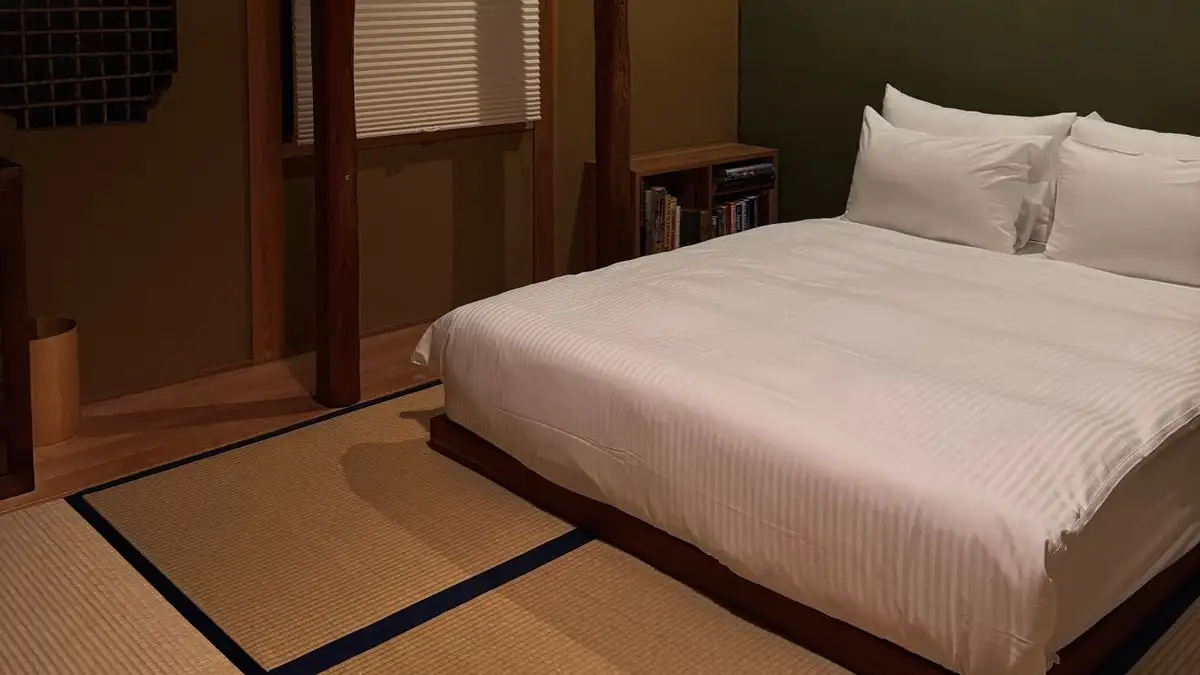
I learned the luggage one first. I had come off a long train ride, dropped the handle on a wheeled bag, and rolled it two steps onto the floor before anything registered. The floor was a grid of pale mats with dark cloth borders, and the wheels made a dry, papery crunch, like walking on a broom. That crunch is the reed surface compressing. It does not spring back, and it is still there months later. Nobody said a word. Someone just gestured at the step down at the entry, and I understood the bag had been supposed to stay there. That is where it has stayed ever since.
The tatami is the room, not the carpet in it
Tatami is a woven reed surface, soft rush woven tight, sitting over a compressed core, and the whole panel rests on a wooden floor. The mats are separate pieces bound along their long edges with a strip of cloth, and they are arranged in a layout that was planned rather than stacked. In a traditional layout, four mat corners never meet at a single point, which is an old avoidance rather than a structural need. That detail matters less than the conclusion: the floor was designed, it is maintained, and the rules you are about to bump into exist to keep it intact.
What damages it is point load and grit. A chair leg. A hard heel. A suitcase wheel. A dropped hard object. Moisture too: a wet glass ring, a towel left sitting on reed. And dirt tracked in from outside, which is the entire reason there is a step at the room's entry in the first place.
So the answer is socks or bare feet once you are on the mats. Slippers come off at the edge. Shoes never get that far.
One thing worth knowing before you compare rooms: mats are not one universal size. Kyoto mats run a little longer than Tokyo mats, so a mat lands somewhere around 1.6 to 1.8 square meters depending on where you are. An eight-mat room is not a fixed number of square feet. You will feel the difference in the room long before you do the arithmetic.
Where the room actually ends
Most rooms have a small unfloored entry inside them, a patch of wood or stone one step below the mats. That patch is where the slippers sit and where the bag goes. It is the airlock between the corridor and the reed.
Three surfaces, three footwear states, and they do not mix. The corridor is room slippers. The tatami is socks or bare feet. The toilet has its own pair, placed inside its door, on tile. You step out of the room slippers, into those, and back out again on the way through.
The toilet pair is the one with a witness. It is almost always a visually different pair, a plain vinyl set against fabric ones, so anyone in the corridor can see at a glance that you are wearing the wrong shoes. It is the single most common first-night error, and it is the one that gets noticed. Walking out with them is not a disaster, but it is a small public tell.
If your room has its own bath, that floor is a wet room with a drain. Water stays there. Two wet steps back onto reed is how a room gets a permanent stain nobody can fix.
Leaving your corridor slippers pointed at the doorway so you can step straight back into them costs nothing and looks like you have done this before.
The room is a sitting room at three and a bedroom at nine
The futon lives in the oshiire closet during the day, stacked with the sheets and pillows. In the evening, usually while you are at dinner, staff come in, pull it out, and lay it on the mats. This is the part that surprises people who have only stayed in hotels: the room you booked is two rooms, and you only see one of them at a time.
If the room is six mats and there are two of you, the mats are now essentially all bed. Some rooms leave the low table in the middle and build the bedding around it, which tells you exactly how much floor is actually in play.
A few consequences fall out of this, and they are the ones I watch new guests trip over.
Do not leave anything on a laid-out futon. Phones, glasses, a paperback, a charging cable: all of it gets folded away with the bedding in the morning and ends up in the closet. Do not treat the closet as luggage storage either. It is sized for futon, staff need it twice a day, and a bag jammed in there causes a small problem for someone every single morning.
On a multi-night stay the room resets daily. Anything you leave on the floor gets moved, and it will not be where you left it.
And if you are not going to dinner, say so at the desk. The room cannot be made up while you are sitting in it. Staff will work around you if they have to, but the whole evening schedule assumes you are out between roughly dinner and your return.
The bedding itself lies directly on the mats. It is firm, closer to a good floor mattress than to a hotel bed with a box spring under it. That is the trade you made for the room. Some people sleep better on it than they have in years, and some people do not sleep at all.
The clothes on the hook belong to the building
A yukata and a light outer robe are there for moving between your room and the bath, and for walking to the dining room or the lounge. The yukata is the base layer; the robe goes over it. Both are for inside the building.
Wearing it is not complicated, but there is one direction that matters. The left panel goes over the right, as you look down at yourself. If you get it backwards, right over left, that is how a body is dressed for a funeral, and it is the one mistake that people in Japan will actually correct, sometimes by reaching over and flipping it for you. The belt goes at the waist and should be snug. If the yukata is too long, take the extra length up at the waist under the belt rather than letting it trail at the hem.
About going outside in it: this is genuinely an it-depends. In a hot-spring town with a pedestrian street, walking between bathhouses in yukata with the outer robe and the wooden sandals by the door is normal, and honestly it is part of why people go. In a city-center ryokan, walking to the convenience store in it is not. If you are unsure, ask the desk. That question gets asked constantly and nobody will blink at it.
One last thing: the yukata is not a souvenir by default. It stays with the room unless the property sells you one.
The mat count is the only size number that means anything
Ryokan rooms are sold by mat count because the mats are the room. Six, eight, ten, twelve. What that number describes is the tatami area only. It does not include the entry step, the closet, the bathroom, the toilet, or the narrow wooden veranda strip along the window.
That means two listings with the same square footage can be very different rooms, and a listing with a smaller number can be the better one. Where a booking page gives you both a mat count and a square-meter figure and they seem to disagree, trust the mat count. The square meters usually describe the whole footprint including the entry and the bath, which is not where you live.
As rough sizing: a six-mat room is about ten square meters of tatami, comfortable for one and close for two, with no open floor once the bedding is down. Eight mats runs somewhere around thirteen to fourteen and a half square meters, which is the common comfortable size for two. Ten mats and up gives you actual daytime floor, and sometimes a second sitting area by the window.
The number that catches people is six. It reads like a small hotel room and behaves like a large closet with a view.
What the room assumes you already know
The low table is the only horizontal surface at a usable height, and it is knee-high. Tea set, thermos of hot water, and that is the extent of the workspace. If you plan to answer email for two hours, plan to do it in the lobby or a cafe, because there is no desk and no chair, and sitting on a cushion at a knee-high table stops being charming at about the forty-minute mark.
Anything wet goes on the table or on a tray, never directly on reed. A water ring on tatami does not come out.
The recessed alcove, the tokonoma, is the room's display corner. There is usually a hanging scroll and a single flower or a ceramic piece in it, and it is not where the bags go, or the wet umbrella, or the shoes. Nothing bad happens if you use it, but it reads immediately as not knowing what it is for.
If there is a second sliding door you did not come in through, keep the path to it clear. That is the staff entrance, and it is how meals and bedding arrive.
And the paper screens: push the wooden frame, not the paper. Do not lean on them, do not stack anything against them. They tear, and they do not get replaced mid-stay.
The room is not being fussy. It is a single-purpose object with a narrow set of correct uses, and the correct uses are all physical rather than ceremonial. Learn four placements in the first ten minutes, where the bag goes, where the slippers go, where the cups go, where the clothes go, and the room stops feeling like a set of rules and starts feeling like a machine that works. The first night is usually the only night you get it wrong.