A ryokan meal plan is a schedule, not a menu. Booking on an ippaku-nishoku rate, one night plus dinner and breakfast sold as a single structure rather than a room with a restaurant attached, reserves two fixed appointments at the property, and almost everything else about your evening gets arranged around them. Dinner arrives as a set sequence of small courses at a seating time the inn controls. Breakfast arrives as a set tray at a second fixed time. Bath, sleep, and the change of clothes all fit into the gaps. The food is what people talk about afterward. The clock is what they actually live inside during the stay, and it is the part that surprises first-time guests from the United States most.
I watch for it now at the check-in counter, because that is where the evening gets set. You put the bag down, the passport goes across, and the person at the desk slides a printed sheet toward you. It is a grid of bath times, breakfast times, checkout, with one blank already filled in. That line is your dinner seating. There may be an earlier or later slot still open. If you did not say anything when you booked, this is the last moment where it is a decision rather than a fact. I have nodded at that sheet without reading it, and I have asked to move the line, and only one of those two versions of me sat through a complete dinner.
Nothing on that sheet is something you order. That is the part travelers miss.
The meal plan is one purchase, not a room plus a restaurant
Ippaku-nishoku means one night, two meals, and it is the default way ryokan are sold. You are not booking accommodation and then separately deciding whether to eat there. Dinner and breakfast come bundled into the rate, and the whole thing is usually settled at checkout rather than paid at a table, with no tipping expected at any point.
The practical consequence is that at a lot of properties, especially in onsen towns, the meal plan is not an upgrade. It is the only dinner in walking distance. Resort towns around hot spring inns tend to shut down early. The shops serving lunch close, the streets go quiet, and the inn's dining room is the functioning restaurant for the night. I have watched people book a room-only rate to keep their evening flexible and then spend it looking for food. Before you strip the meals off a booking, check what is actually open around the property at that hour. Often the answer is nothing.
Room or dining hall: two different evenings
Where the meal is served changes the shape of the night more than the menu does, and it depends on how the property is laid out.
In the guest room
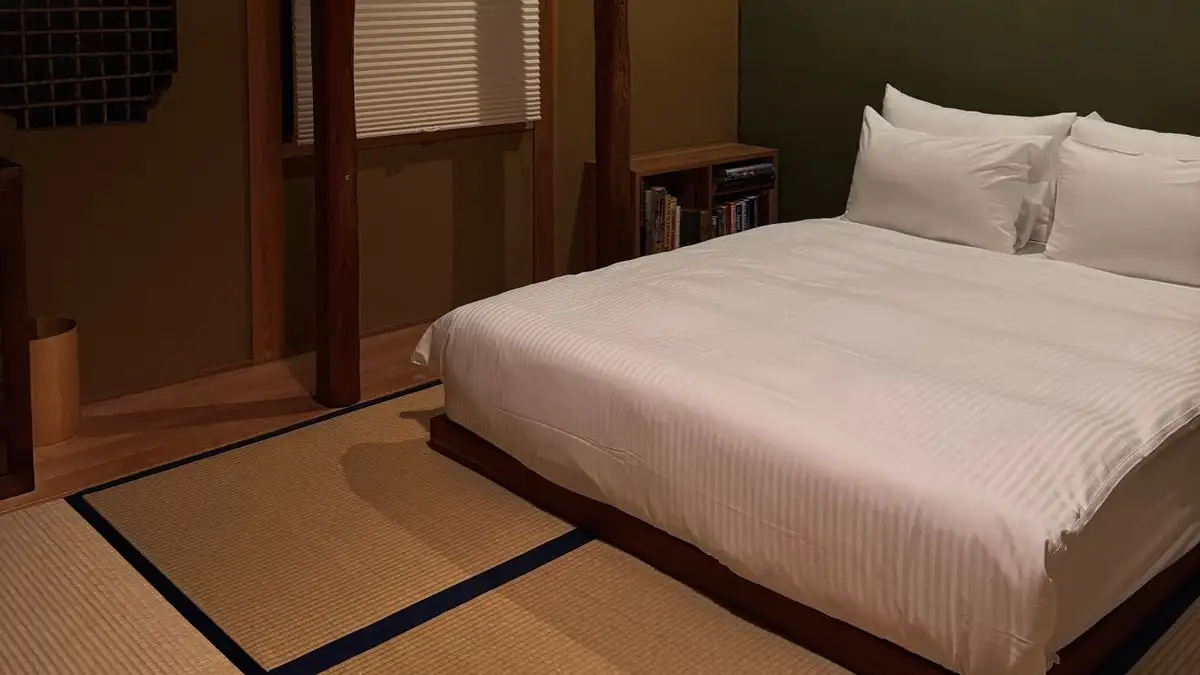
At a smaller or more traditional inn, staff bring the courses to your room and take them away in stages. You eat at a low table on the tatami, and someone comes in and out on a rhythm you do not control. It is private, and it is also your whole evening's location. You cannot wander during dinner because dinner is happening in your bedroom, and the room has a second job. In the common pattern, bedding gets laid out in that same space later, either while you are at the bath or after the trays are cleared. The room becomes a dining room and then a bedroom again on the inn's schedule, not yours.
In a communal or private dining room
At larger properties you walk to dinner instead. Guests typically come down in the inn's yukata at the assigned time and are seated at tables tied to their rooms. If the property has small private dining rooms, you get one of those instead, which is a middle case: your own space, but in the dining wing rather than your room. Either way, dinner has a start time that everyone shares, and the room fills at once.
I prefer the dining room for a selfish reason: it makes the clock visible. When everyone is walking down the corridor in the same robe at the same moment, you are never guessing about whether you are late.
The sequence arrives on someone else's pacing
A kaiseki-style dinner is not a plate of food. It is a run of small courses served in an order the kitchen sets, and the pacing is part of the format. Courses land one or two at a time. There are gaps. The whole thing takes a while, and the length is the point. It is an evening, not a meal you finish and leave.
Which is why lateness is so costly. Arrive at the seating late and the kitchen has a choice between compressing the sequence into whatever time is left and dropping the tail end of it. Neither is a refund situation. It is just what happens when a fixed sequence meets a fixed end time. Many properties set a last check-in time specifically to protect the dinner seating, and that number matters more than most people treat it. If your train out of Tokyo is delayed, call the inn.
Here is the part I did not understand until I had done it a few times: the bath has to fit before dinner, not after. You check in, you change, you go soak, you come back, you eat. Skip the soak and you have paid for an onsen and used it as a hotel. Try to soak after dinner and you are often too full and too tired, and the bath may be closed by then anyway. The evening has a sequence to it, and dinner is not the first item on it.
Breakfast is the same idea, compressed
Breakfast is a set tray, not a buffet and not a menu. In the standard format it comes as rice, soup, grilled fish, and pickles, plus whatever the property adds around that, and it lands at the time you wrote on the sheet at check-in. There is no ordering. You sit, it appears, you eat it, and it is usually tied to a checkout that arrives sooner than you want.
Some inns do run buffets, which is a genuinely different experience and worth checking before you book if the set tray is not what you are after. Coffee is not guaranteed. If that matters to you, ask when you book rather than at the table.
Everything negotiable is negotiable at booking
The staff working the dining room during service are executing a plan that was made before you arrived. They can hand you a tray. They cannot rebuild the tray.
So the requests go in at booking. Allergies and dietary restrictions. Raw items you would rather not have. A later seating because your flight lands in the afternoon. A private dining room. Children's portions. A vegetarian or pescatarian version of the sequence. Every one of those is easy to handle weeks ahead and somewhere between awkward and impossible to handle at the table. I have watched people try, and the person doing the trying is always more frustrated than the staff.
The one live decision at the table is usually drinks, which you order there and settle at checkout like everything else.
What you are trading away
The title of this article is not a complaint. It is the actual arithmetic. A ryokan night is not one night out of your Tokyo itinerary. It is a Tokyo evening and a Tokyo morning.
To make the seating, you leave the city in the afternoon. You are not doing a full day of museums and then heading out. You are not doing dinner in the neighborhood you wanted to try. Whatever you would have done between late afternoon and bedtime in Tokyo, you are doing on a tatami floor instead, on a schedule, and then the next morning you are up for breakfast on the inn's clock and out by checkout. Two fixed points, one at each end of the stay.
What you get for that is an evening with no decisions in it. No reservations, no transit, no hunting for a table, no negotiating a check. One continuous block of time in one place, with someone else running the sequence. Whether that is a good trade depends entirely on how many nights you have. On a four-night trip, one ryokan night costs you a quarter of your Tokyo time and delivers one of your four dinners. On a longer trip, it is the reset in the middle.
What I would tell anyone booking their first one: read the sheet at the counter, ask for the seating that fits your arrival, arrange the food requests before you travel, and treat the evening as the thing you bought. Not the room. Not the meal. The evening.