Plan a Tokyo day by rail corridor and by station exit, not by map proximity. Two stops that sit a half-inch apart on a phone screen can be twenty minutes of walking apart once you account for the side of the tracks, the level you're standing on, and which company's fare gate you have to pass through. Two stops that look unrelated on a map can be eight minutes on one line. The exit number, not the address, decides whether the last leg of the trip is three minutes or fifteen.
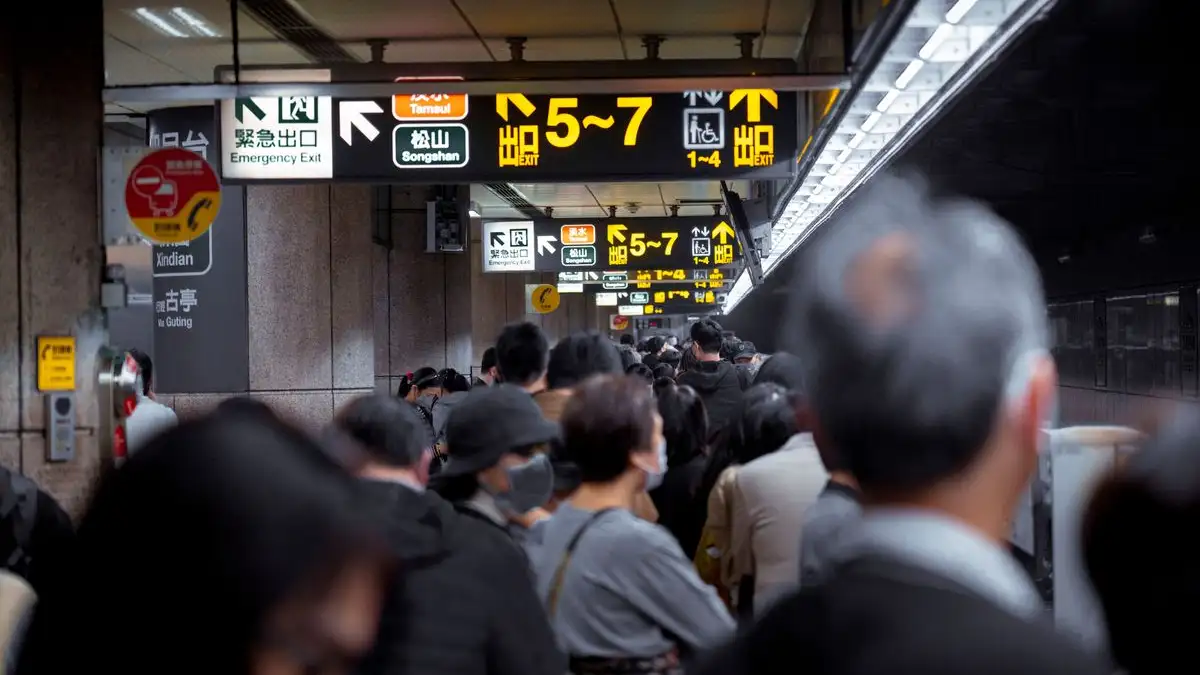
I'm standing in a concourse with you, phone held at chest height, and the problem is visible before either of us says anything. There's a pin on the screen for the place we're headed. It looks like a short walk. It is not a short walk. That pin sits on the other side of the tracks, one level down, off an exit we are nowhere near, and the exit we're standing under puts us on a side of the road we cannot cross from here. No crosswalk. Just a railing and traffic.
I did that walk three times on one trip before I stopped calling it bad luck. It wasn't a walking problem. It was a planning problem, and the fix was ordering things differently before I ever left the hotel.
Pick the line first, then the places on it
The map app wants to hand me one dot at a time. That's the wrong unit. The unit is the corridor, the single line I'm going to stay on for the middle of the day, with stops hung off it like beads.
I choose the line, then I choose which stops on that line matter, then I put them in the order the train already runs. Nearest-first on a map is a trap, because "nearest" is measured through the air, and you are not traveling through the air. You're traveling through a station, out a specific exit, along a street, and back in through a different gate.
The payoff is arithmetic. Every switch between corridors costs a walk, a gate, and usually a wait. Four stops strung along one line cost four platform waits and nothing else. The same four stops scattered across three lines cost three transfers on top of the walking. Over a full day that's close to an hour, and it's an hour spent in concourses, which is the least interesting hour Tokyo sells.
The gates belong to companies, not to the station
Here's what the map never shows. Inside one station complex you can have JR, Tokyo Metro, and Toei all sharing a roof, and none of them share fare gates. Walking from a JR platform to a Metro platform means tapping out of JR and tapping in at Metro. Two gates, two taps, and the beep on the way out is a different beep than the one on the way in.
Nothing is broken. That's just how the systems are drawn. But it means a transfer is not a hallway. Sometimes it's a two-minute walk inside the same building. Sometimes it's considerably more, and at the biggest stations, Shinjuku and Shibuya especially, changing lines can genuinely take longer than the ride between the two stations you were trying to connect.
So when I price out a day, I count switches, not kilometers. A day on one corridor has one switch in and one switch out. A day built from map pins can have five, and each of those five carries a small chance of being the one that eats twenty minutes.
Exits are not interchangeable
North is not simply the mirror of south. At a large station, the east exit and the west exit can be ten minutes apart even though they are the same building, and if you come up on the wrong side you often cannot just cross over. You're facing a rail embankment, a divided road, or a wall of buildings with no cut-through.
What I actually read on the sign wall isn't the exit number. The number is for me. The useful part is the name printed beside it. Tokyo exits are frequently labeled by the building they empty into, a department store, a bank, a hotel. That name is the real landmark, and it's what a passerby will use if you ask for help. When a station hands you an exit letter and a department-store name on the same plate, both are telling you the same thing in two languages.
Station numbering is the shortcut past the kanji
Every line has a color and a letter, and every station on it carries a number. That's a system built to be read without Japanese. On a sign wall with six lines stacked on it, you match the color band and the letter, count to your number, and you know you're in the right place.
The catch is that a complex with three companies in it has three numbering schemes on the same wall. JR's numbers, Metro's numbers, Toei's numbers, each with its own color family. The number only helps if you already know which line's numbering you're looking for before you look up. That's the same discipline as the corridor rule: decide first, read second.
Express services quietly reorder your itinerary
Not every train stops where you do. Rapid and limited express services skip stations, and the whole point of a corridor plan is that your stops are the ordinary ones. If I've strung four local stops together and the next train through is a rapid, I ride past two of them and pay for it in backtracking.
So itinerary order has to match the service type. Either everything on the corridor is a local-stop day, or the skipped stations are ones I've already decided to skip. I don't need a timetable in my head to hold that rule. I need to know which service I'm standing on, and the board above the platform tells me that much.
What I actually write down
Three lines per stop, no more. The line name, the exit name or letter, and whether it's a local stop for the service I'm taking. That's the whole note. It goes in a notes app, not a spreadsheet.
Then, on the train, one habit that saves more walking than anything else: I read the exit off my notes before the doors open. Everyone around me is going to stop dead in the concourse and study the sign wall. I'd rather be walking while they're reading.
When the corridor rule loses
It isn't always right. If the whole day is one destination, one museum or one neighborhood you want to sit in, then proximity wins and you should just go directly and forget the corridor. If a place is genuinely worth crossing the city for, cross the city for it. The rule is about how to sequence a day, not about refusing to travel.
The other honest limit is that some exits close in the evening. Not many, and rarely the main ones, but it happens, and a late dinner built on one specific exit is worth a quick check before you commit to it. Nobody mentions that until you're standing at a shuttered gate at ten at night, which is where I learned to check.
The cost of all this is small. Nobody's trip gets ruined by a wrong exit. But a wrong exit repeated four times in a day is a day that feels longer and thinner than it needed to be: more escalators, more gate beeps, more standing at a sign wall deciding. Build the day along one line, resolve each stop to an exit before you leave the hotel, and the city gets smaller in the way you actually want it to.