A family gets through a Tokyo station cleanly when the exit is chosen before the ticket gate, not after it. Pick one numbered exit for each end of the trip, confirm that exit actually connects to an elevator, and let that pair of exits decide which line you take, which car you board, and what hour you travel. Everything else that goes wrong with kids in a station — the card fumbling, the luggage, the rush-hour crush — sits downstream of that one decision, because a station exit number is not a suggestion. It is a coordinate, and it decides whether the last two hundred meters of your walk is a lift or a staircase.
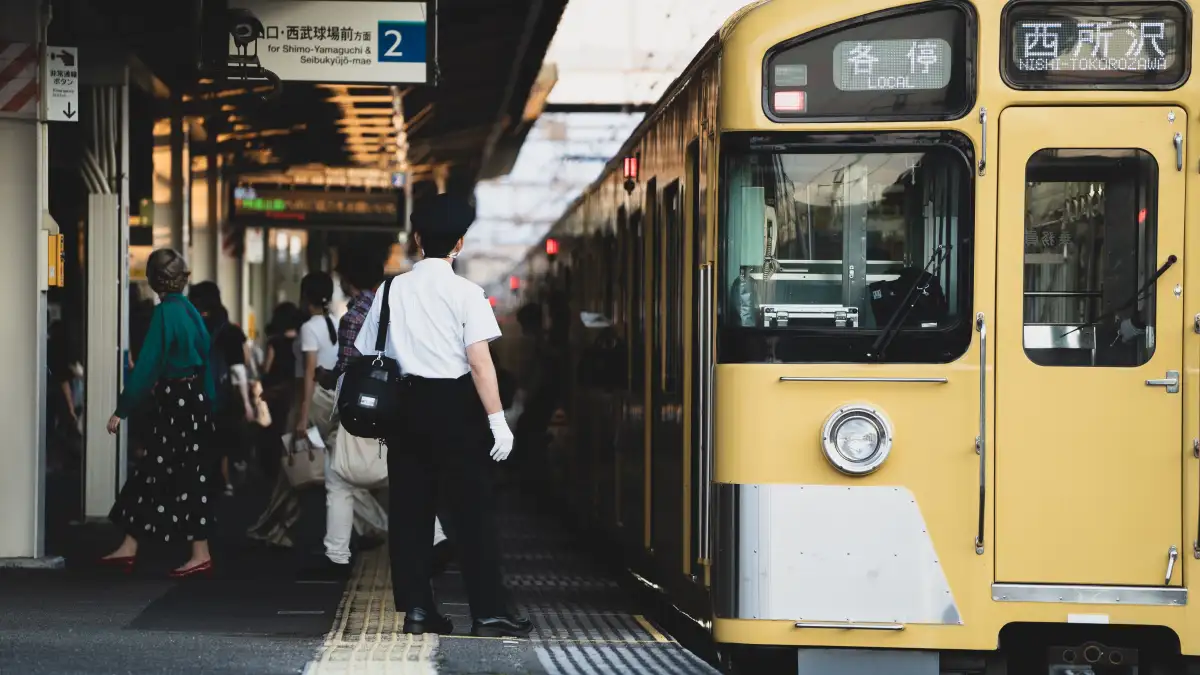
Stand with me at the top of a concourse in a big Tokyo hub at 8:10 on a weekday morning. The floor is pale grey tile, polished enough to throw back the light from the signs hanging overhead. There's a low rumble from somewhere below, half train and half ventilation. The signage band runs above your head in green and white and blue, and it is dense: line names, station numbers in letter-and-digit pairs, arrows pointing down corridors that split five ways.
What you'll notice, if you stand still for ten minutes, is that almost nobody else does. A river of people comes up the stairs and keeps moving, and they don't read the signs, because they already know where they're going. The only people standing still are the ones reading. Most of them are holding a suitcase handle, or a stroller, or both.
That's the shape of the problem. A meltdown in a Tokyo station has almost nothing to do with walking distance and almost everything to do with how many times your group stops to make a decision in a crowd that will not stop with you. I've watched a family cover a long, flat, well-signed stretch of concourse and arrive calm. I've also watched a family come apart inside a hundred meters, because they stopped twice.
So the skill isn't navigating. It's sequencing.
Exit first, and mean it
Every station in the Tokyo system numbers its exits, and the numbers appear in three places: on the hanging signs above you, on the platform, and on the street-level maps outside. Major hubs use letter prefixes, which is the detail that catches visitors. Exit 3 and Exit A3 are different places, sometimes several minutes of walking apart. When you see a sign that says B7 with an arrow, that arrow is not decorative. It's the difference between a lift and forty steps.
The number matters more than the name. English exit names like "East Exit" are often loose translations, and at the big hubs there is sometimes more than one thing called East. A number is unambiguous.
The other thing that isn't obvious from a map: JR East, Tokyo Metro, Toei, and the private railways operate their own gates, hang their own signage in their own colors, and place their own elevators, even when they occupy the same building. "Shinjuku Station" as a single entity doesn't really exist in a way that helps you. Look the routes up per line, not per station name. A station map published by one operator may simply not cover the concourse you'll actually be walking through.
The night before, open the operator's station page — all the major ones publish maps with elevator and accessible-route markings — find your two exits, and screenshot them. Below ground, in my experience, the signal drops right at the moment you need it most.
The vertical part nobody plans for
The elevator pictogram on a hanging sign will often point you off the main flow, backwards, or down a side corridor that feels like it's leaving the station entirely. It usually is leaving the main flow. Follow it anyway. That detour is the route.
Elevators in Tokyo stations are single-file, slow, and in peak periods there's a queue at the door. With one adult and two kids plus a stroller, the elevator is almost always the right call. With two adults, the calculus changes: one adult folds and carries the stroller, the other holds hands, and the stairs are genuinely faster. That's a real tradeoff, not a rule.
Don't plan an escalator with a stroller. Many stations ask you not to, and at some, escalator direction flips between morning and evening, so the way down you used yesterday may be the way up today.
At the gate bank itself, look at the end. There's usually a wider gate marked with a wheelchair pictogram. It opens more slowly than the others, which is exactly why it exists: a stroller goes through it without a shove. Use it, and expect to wait a beat longer.
Child IC cards are a separate logistics problem
Adults have this easy. Suica or Pasmo in your phone wallet, topped up, tap and go. Mobile cards are adult cards, though. Children's cards are physical, issued at the station office window with ID, which means a stop, a queue, and a conversation before your first ride.
The rules are age-based and applied automatically at the gate. Preschool-age children ride free and don't tap at all. School-age children need their own card and their own tap. You cannot tap one card for two people — the gate counts people, not cards.
The physical mechanic that trips families up: the tap pad sits on top of the gate, and children have to reach for it. Let the child go first, tap, and walk through, then you tap and follow. Two people tapping the same gate at the same time produces a beep and a small public scene. If your child is too short to reach, look for the gate with a lower reader, which many stations have at the end of the bank.
Keep the child card somewhere it can't be dropped — a case on a lanyard around the neck works better than a pocket. And know that if you exit through the wrong gate, you're out; re-entering means tapping again. If you end up somewhere unexpected, the fare adjustment machines inside the gates handle it and you're not trapped.
Rush hour has a shape
Weekday crowding runs roughly 7:30 to 9:00 in the morning and roughly 17:00 to 19:30 in the evening. Shifting a family outing to mid-morning or mid-afternoon is the single largest comfort upgrade available, and it costs you nothing but a later start.
Crowding also isn't uniform inside a train. The ends of the train are usually lighter than the middle, and the middle is heaviest right where the stairs and escalators land on the platform. Walk the platform before you queue.
This is where the exit decision pays off twice. Platform floors carry car-number markings. Choose your car by where you want to arrive, not where you happen to be standing. If your arrival station's elevator sits nearest the last car, walk to the last car now, and the whole exit problem at the other end disappears before you've boarded. Some cars carry restrictions during certain hours; the markings on the floor and the signs on the car say so, and they're worth reading once before you commit.
Transfers deserve the same suspicion. Two stations that look like one blob on a map can be a long underground walk with a stroller and a tired child, and the transfer is measured in the walking, not in the diagram.
Decide about the bags before you leave the hotel
Coin lockers come in sizes from small to large and are paid by IC tap, and the large ones at hub stations are usually gone by mid-morning. If your plan depends on finding a large locker at a major station in the middle of the day, your plan is fragile.
Luggage forwarding is the better answer for most families. Hotel front desks and convenience stores ship bags, most routes on a next-day basis, and it converts a station transit day from four suitcases into a daypack. Send it the night before, not the morning of. There's no version of this where doing it at 7:45 a.m. feels good.
The rule I use: whatever you'd have to carry through a ticket gate at 8:15 in the morning is the amount you should be carrying. Everything else gets shipped or locked.
If someone gets separated
Pick the meeting point before you go through the gates, not after. Two good choices: a specific numbered exit at street level, or the station office window inside the paid area. Both are fixed, and both are staffed.
Station offices are staffed by railway employees, and bringing a separated family member there is standard procedure. Staff can make announcements. That's the mechanism, and it's reliable.
Give younger children two facts only — the station name and the line color or name. Not the exit number. They will not remember the exit number, and asking them to try is worse than useless.
Also decide the door policy in advance. If a door closes between you, do you get off at the next station and come back, or does the person left behind stay put? Pick one before the trip and say it out loud to everyone, so nobody has to invent a plan while panicking.
The boring walk is the goal
The best family transit day I've had through a Tokyo station was uneventful. We knew the exit number, we knew which car put us near the elevator at the far end, the child cards were already on lanyards, and we never once stopped moving to read a sign. Nobody remembers it. That's the point.
The sequence is always the same: exit first, then the vertical route, then the cards, then the hour, then the bags. Get the order right and the station stops being an obstacle and turns into a corridor.