Hotel and ryokan staff in Japan are not waiting for a tip, and cash left in a room is read as found property rather than as gratitude. The two lodging types also run on different money models, which is why the same quiet checkout means two different things: a commercial hotel prices its labor into the room rate and staffs no gratuity role at all, while a ryokan prices the room, the meals, and the attendant's service as a single figure before you ever arrive. Nothing is expected on top of either. The only move that reliably causes a problem is leaving money behind in the room, and what it causes is a lost property entry, not a thank you.
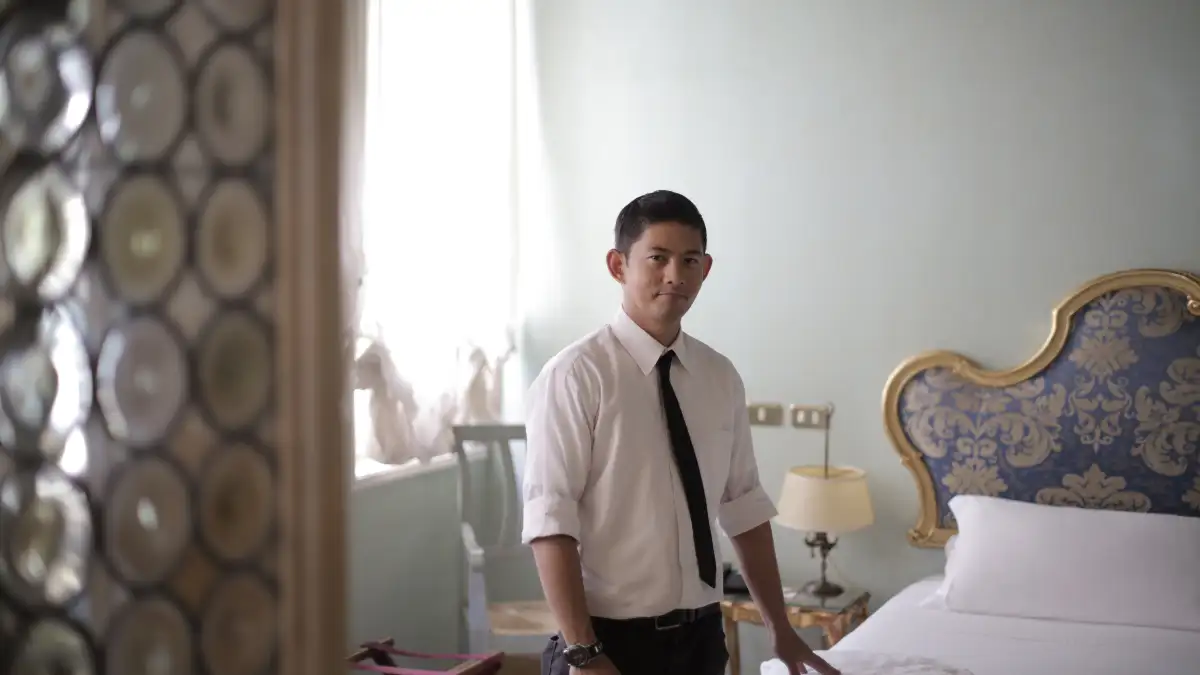
I have stood in the middle of that room more than once. Shoes off at the entry step, tatami cool through socks, a low table with a covered teapot, two cups, and something seasonal under plastic wrap. The attendant, the nakai, slides the door open from her knees, sets the tray down, says the handful of sentences she says to every guest, and slides it shut again. No bill in her hand. No place in her day for one. That room is the whole argument.
Now picture the other building. Elevator chime, key card, a tray of free face masks by the front desk, a floor map taped inside the elevator door. You have a bag. You carry it. Nobody offers to take it, and nobody is scheduled to offer. That is not a snub. It is a staffing chart.
The Hotel Side: No One Is Staffed for It
Japanese commercial hotels are built on the assumption that the price on the booking is the price. There is no porter position in the model, so there is no porter to tip. Housekeeping is not tipped either, and not because the work is invisible to management. It is simply that the wage structure already accounts for the work, and the guest is not part of the payroll.
At a hotel flying an international flag, you will sometimes find someone at the desk who knows the gesture from abroad. They may accept it politely. They may take it because refusing it would create a longer, more awkward exchange than accepting it. Neither of those is the same as expecting it, and neither one changes what the rest of the staff assumes. If you hand cash to one person and not another, the money has nowhere to go in a shared system.
So the default at a hotel is simple. Hand nothing. That is not a lesser choice. It is the choice that matches the building.
The Ryokan Side: The Price Already Contains It
A ryokan does not sell you a room and then sell you service on top. It sells you one rate that covers the room, the meals, and the attendant's time with you, and that rate was calculated long before you made the reservation. Two meals are usually inside it. The tatami, the yukata, the tea service, the futon laid out while you are at dinner, all of it sits inside the same number.
Some high-end ryokan take this one step further and print a service charge as a line item on the bill. That line exists so the guest does not have to decide anything. The discretion has been removed deliberately, and handing cash over at checkout reverses that decision without asking. It also tends to confuse the person holding the bill, who now has an amount that has to be accounted for somewhere.
Kokorozuke, If You Want the Older Form
There is an older practice, and it is worth knowing before you improvise. It is called kokorozuke. A modest amount, in a decorative envelope, offered near the beginning of the stay rather than at the end, to the person who will be looking after the room.
Two things about it matter more than the amount. One is the timing. Offered at the start, it reads as a gesture across the stay ahead. Left at the end, it reads as payment for work already done, which is a different transaction and a smaller one. The other is the envelope. The envelope is the signal. It carries what a folded bill on a counter cannot, which is the message that this was meant as a courtesy and not as forgotten change.
None of this is universal. Plenty of inns will decline it, some will look faintly puzzled, and small family-run places vary more than any category suggests. If you are uncertain, not giving is a completely correct outcome.
The One Mistake That Creates Paperwork
Here is the part that actually has consequences, and it has nothing to do with etiquette.
You check out. You have a couple of bills left and a vague feeling that somebody did something nice. You put them on the pillow and walk to the elevator.
What happens next is not what you pictured. The room is cleaned. Housekeeping finds money on the pillow. They cannot keep it. It is not theirs, and taking it would be a far larger problem for them than for you. So it enters the lost property process, which is a real process with real steps: logged against the room number and date, bagged, walked to a back office, and held for an owner who may never come.
The word the staff use for it is wasuremono, a thing forgotten. A note saying 'for housekeeping' does not move it into a different category, because the process has no tip field. It has one field for money found in a room, and that field is lost property.
Practically, that means the money does not reach anyone. If you are still in Japan, they may try to contact you so you can collect what is technically yours. If you are already in the air, it sits in a drawer of things waiting for owners. Either way, you generated an entry in a log, and somebody had to sit down and make it.
The rule I use: if there is no person to hand it to, it is not a tip. It is a lost item you have just created.
What Reads as Thanks
If you do want to give money, give it to a person, with both hands, in an envelope if you have one, and let it be the older form rather than a correction to the bill.
Everything else on the list costs nothing. Leave the room in reasonable order. Be on time for the meal slot you picked. Write a line of thanks on the comment card that most rooms keep somewhere in the folder with the Wi-Fi details. That card goes to the staff, not to a back office, and staff actually read them.
One caveat worth stating plainly: general practice is not a policy. An international chain, a business hotel, a long-established inn, and a four-room family place will each handle money a little differently, and some of them will surprise you in either direction. What does not vary is the pillow. Cash on a pillow is the one move that reliably creates work for somebody, and the somebody is never the person you were trying to thank.